Aerial Security System

Precision Engineered.
Passive Aerial
Detection.

Passive acoustic detection at 0–5 km, sub-2-second AI classification, and instant operator alerting — no radar, no RF emissions, no electronic signature.

0–5 km
Detection Range
<2 s
Classification Time
24/7
All-Weather Ops
The Problem
The Cost Asymmetry Problem

Early detection
is the most
cost-effective protection.

Detection Range
0 – 5 km
passive acoustic, open terrain
Classification Time
< 2 seconds
on-edge AI inference
False Positive Rate
< 0.1%
field-validated accuracy
RF Emissions
Zero
fully passive — unjammable
Operational Cost
Best Value
no consumables per detection
Cost Asymmetry
Operator deploying Peregrine
Operator Readiness

Two days of training.
AI does the rest.

Traditional aerial detection systems require months of specialist training and a dedicated crew on-site around the clock. Peregrine flips that. Detection, classification, and operator alerting are handled autonomously — any security personnel is fully proficient after a 2–3 day field course. No permanent specialist needed.

2–3 day field course
Full mission proficiency. No prior RF or avionics background required.
Single operator
Deploy, monitor & manage the system solo.
How It Works

Detection in three steps.
Under 2 seconds.

01

Acoustic Detection

0 – 5 km Passive Range

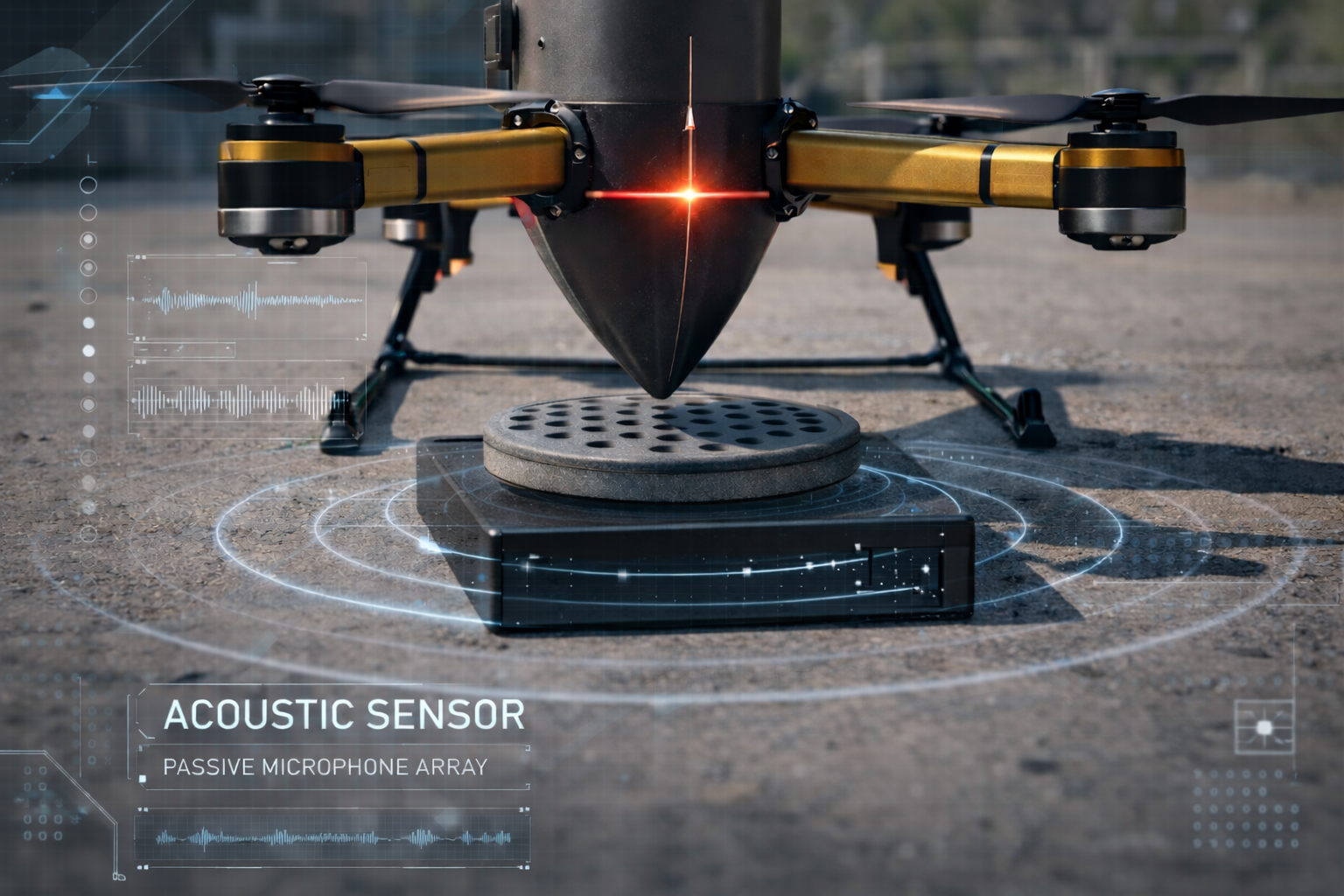
A distributed array of passive microphones continuously monitors the acoustic environment. No radar. No RF emissions. No electronic signature. Low-altitude fixed-wing drones produce a distinct acoustic fingerprint detectable at up to 5 km in open terrain.

Passive · Unjammable · Silent operation
02

AI Classification

Sub-2s Identification

Raw audio is streamed to an on-edge inference engine trained on low-altitude drone and aerial object signatures. The classifier outputs object type, bearing, elevation, and confidence score. False-positive rate below 0.1% in field conditions.

On-edge inference · No cloud dependency
03

Operator Alert

Instant Notification

Bearing, elevation, range, and threat classification are instantly relayed to the operator interface. Configurable alert thresholds and multi-channel notification ensure the right people are informed within seconds of detection.

Operator-notified · Alert-ready · Configurable
AI Acoustic Classification
On-edge AI classification — aerial threat signature identified in under 2 seconds
Acoustic Intelligence

The sensor that
cannot be jammed.

Radar-based detection relies on electromagnetic emissions that can be identified, jammed, or spoofed. Passive acoustic detection emits nothing. It only listens.

Low-altitude fixed-wing drones use piston engines with characteristic acoustic signatures. Peregrine's multi-array passive sensor triangulates bearing and elevation using time-difference-of-arrival (TDOA) across a deployable sensor grid. The system operates continuously without any electronic emission profile.

Detection Method
Passive Acoustic
Array Type
Multi-node TDOA
Bearing Accuracy
± 2°
RF Emissions
Zero
Interference Resistance
Immune
Day / Night Ops
All conditions
Passive Acoustic Sensor Array
Live Acoustic Analysis
Active
MatchFixed-wing UAS — 97.3%
Bearing247° / Elev 8°
Range3.2 km
Est. Time to Zone~68 s
Alert issued — Operator notified
Technical Specifications

Uncompromising quality.
Built for the field.

Acoustic Detection System

Detection MethodPassive multi-node acoustic array
Detection Range0 – 5 km (open terrain)
Array NodesConfigurable (min. 3)
LocalisationTime-difference-of-arrival (TDOA)
Bearing Accuracy± 2°
Classification Time< 2 seconds
False Positive Rate< 0.1% (field conditions)
RF EmissionsNone
PowerBattery / solar hybrid
Deployment Time< 10 minutes per node

Peregrine Aerial Scout Platform

Platform TypeAI-guided rotary-wing aerial scout
PropulsionElectric quad-rotor
Max SpeedAvailable under NDA
Operational Altitude0 – 1,500 m AGL
Primary FunctionAirborne optical confirmation
GuidanceAcoustic cue (5 km→500 m) + AI vision
Optical SensorsIR thermal + low-light optical + AI classification
Authorisation ModeAI-assisted / Operator-authorized
Launch Time< 5 seconds from detection cue
Operational Temperature-20°C to +55°C
Deployment PositioningBest-value · Premium quality
Detection Performance

Best-in-class detection.
Zero emissions.

<2s
Classification Time
Acoustic detection to identified threat
5 km
Passive Detection Range
No radar required
<0.1%
False Positive Rate
Field-validated AI accuracy
0 RF
Electronic Signature
Fully passive, unjammable
Peregrine Aerial Scout in Flight

Acoustic detection. AI classification. Visual confirmation.

Acoustic cue guides the aerial platform to visual range. Onboard IR thermal and low-light optical sensors provide positive visual confirmation — no GPS required.

Deployment Scenarios

Where Peregrine
deploys.

Peregrine Field Deployment

Energy & Industrial Facilities

LNG terminals, petrochemical plants, and power generation sites. Persistent acoustic monitoring provides early warning of aerial activity — giving operators maximum response time for high-value energy infrastructure.

Critical Infrastructure

Power grids, water treatment facilities, energy infrastructure, and port logistics. Fixed sensor arrays provide 24/7 acoustic coverage with sub-2-second detection, requiring no radar emissions that could reveal the sensor position.

Remote & Temporary Sites

Rapidly deployable sensor nodes configured in under 10 minutes. Provides a passive acoustic detection perimeter for remote installations, construction sites, and temporary facilities requiring discreet aerial monitoring.

Contact

Request a Presentation.

Available to organisations interested in passive aerial detection for energy facilities, critical infrastructure, and industrial sites. We welcome exploratory conversations and technical demonstrations. All enquiries are treated in confidence.

All enquiries are treated in strict confidence. We respond to every serious inquiry within 2 business days.